
Subscribe to our Newsletter
SHARE THIS BLOG
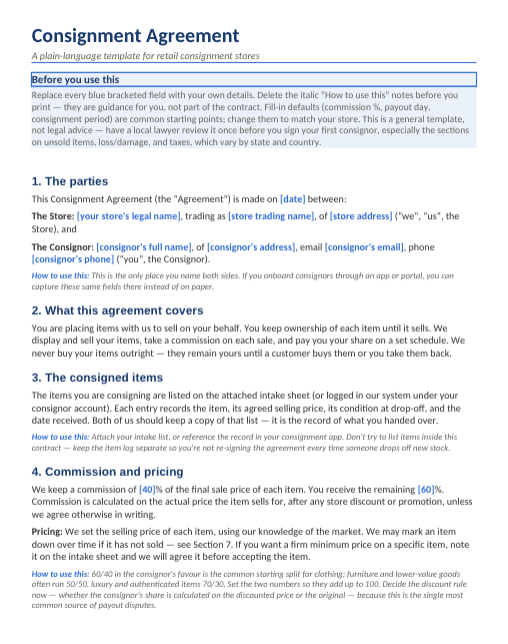
A consignment agreement is the one document that keeps consignor relationships clean, it sets the commission split, the payout schedule, and what happens to items that don't sell, in writing, before the first item hits your floor. This free template covers all of that in plain language, with sensible defaults already filled in. Download it, swap in your own details, and you have a working agreement in ten minutes.
Below the download you'll find a short guide to what every consignment agreement should cover, so you understand each clause before you sign anyone.
Get the free template
Enter your email and we'll send you the editable consignment agreement as a Word document you can fill in and print. No cost, no catch.
Send me the template
Fine print under the button: We'll email you the template and occasional consignment tips. Unsubscribe anytime.
What a consignment agreement must cover
Every consignment agreement, whether it runs one page or ten, needs to answer the same handful of questions. Get these right and most disputes never happen.
Commission and pricing
State the split as two numbers that add up to 100, for example, the store keeps 40% and the consignor keeps 60%. The single most important detail here is often skipped: say clearly whether the consignor's share is calculated on the price an item actually sells for (after any store discount) or on the original listed price. Ambiguity on this one line causes more payout arguments than anything else. Also state who sets prices, usually the store, and whether a consignor can set a firm minimum on a specific item. For where to pitch your split by category, see our consignment commission rates guide.
Payout schedule and method
Spell out how often you pay (monthly is standard), on what date, by what method (PayPal, Stripe, bank transfer, or store credit), and any minimum balance before a payout is sent. Tie the payout timing to your return window: you don't want to pay a consignor for a sale a customer can still return. A short guide to automating this is in our piece on automating consignor payouts on Shopify.
Return hold period
If a customer returns an item after the consignor has been paid, you're left clawing money back. Avoid it by holding each sale for a set period, matched to your store's return policy, before it becomes payable. Sales inside that window show as pending, not paid.
Items that don't sell
Be explicit: how long is the consignment period, do you mark items down automatically if they linger, how long does the consignor have to collect unsold goods, and what happens if they don't. Vague unsold-item terms produce the ugliest disputes. A clear "we may donate uncollected items after X days" line protects you from storing abandoned stock forever, as long as it's stated up front.
Ownership and responsibilities
The consignor should confirm they own each item or have the right to sell it, and that nothing is stolen, counterfeit, or subject to someone else's claim. This one warranty puts responsibility for a bad item on the person who brought it in, not on your store.
The agreement should also cover who bears the risk of loss, theft, or damage while items are in your possession, rules here vary by location, so it's the section most worth a lawyer's review.
From paper agreement to automated tracking
A signed agreement sets the terms. The harder part is living up to them across dozens of consignors, tracking who owns what, applying the right split on every sale, holding returns, and paying everyone accurately and on time. That's the job spreadsheets stop doing well past about fifteen consignors.
This is what consignment software handles: it ties every item to its consignor, calculates the split at the point of sale exactly as your agreement specifies, holds sales through the return window, and pays your whole consignor base in one batch. Your agreement says what should happen; the software makes it happen automatically. If you run on Shopify, PuppetVendors does all of this natively, commissions, payouts, and a self-service portal where each consignor can see their own sales and balances.
FAQs
Is this consignment agreement template free?
Yes. Download it, edit it, and use it at no cost. We only ask for an email so we can send you the file.
Can I edit the template?
Yes, it's an editable Word document. Every field you need to change is marked, and common terms like the commission split and payout schedule come pre-filled with sensible defaults you can adjust.
Is this legal advice?
No. It's a general template to start from, not legal advice. Rules on unsold items, loss and damage, and taxes vary by state and country, so have a local lawyer review it once before you sign your first consignor.
What should a consignment agreement include?
At minimum: the commission split, how and when consignors are paid, a return hold period, what happens to unsold items, and each side's responsibilities including who owns the goods and who bears the risk of loss.
How do I manage consignment after the agreement is signed?
The agreement sets the terms; software enforces them. Tools like PuppetVendors track each item to its consignor, apply your commission rules automatically, and handle payouts, so the terms in your agreement run themselves.