Subscribe to our Newsletter
SHARE THIS BLOG
If you're researching consignment software, SimpleConsign is probably on your shortlist. It's one of the most established names in the space, with over 700 reviews and a reputation for strong customer support. For consignment stores that need a standalone POS and inventory management system, it's a solid choice.
But if your store runs on Shopify — or you're planning to build on Shopify — SimpleConsign introduces a set of compromises that don't show up on the pricing page. The Shopify integration is only available on their most expensive plan at $359 per month. It doesn't work with Shopify POS. Product edits you make in Shopify get overwritten during nightly syncs. And you're required to use their proprietary payment processor, SimplePay, instead of Shopify Payments or any other processor you prefer.
This article breaks down what each approach actually involves so you can decide which architecture fits your consignment business.
Two Fundamentally Different Architectures
Before comparing features, it's worth understanding that SimpleConsign and Shopify + PuppetVendors represent two completely different approaches to running a consignment store online.
SimpleConsign is a standalone system that connects to Shopify. It maintains its own database, its own POS, its own payment processor, and its own inventory records. Shopify exists as an add-on channel — a place where SimpleConsign pushes product data outward. SimpleConsign is always the master. Shopify is always the follower.
PuppetVendors is a Shopify-native app that adds consignment capabilities to your existing store. There's no separate system. Products, orders, customers, and inventory all live in Shopify's database. PuppetVendors adds the layer that Shopify doesn't provide natively - commission tracking, vendor payouts, vendor portals, and multi-vendor management. Shopify handles what Shopify does best: storefront, checkout, POS, payment processing, shipping, and the entire app ecosystem.
This isn't just a technical distinction. It determines your daily workflow, what your consignors experience, what your in-store staff can do, and how much you pay every month.
Pricing: What You Actually Pay
SimpleConsign's pricing looks straightforward until you factor in which features require which plan.
SimpleConsign offers three tiers. The Basic plan costs $159 per month and includes unlimited consignors, unlimited inventory, their POS, and integrated payment processing through SimplePay. The Standard plan costs $259 per month and adds ACH consignor payments, consignor portal access, and scheduling. The Professional plan costs $359 per month and adds AI item entry, Shopify integration, QuickBooks integration, and cloud printing.
If you want to sell online through Shopify, you need the Professional plan at $359 per month. There is no way to get the Shopify integration on a lower tier. Add your Shopify subscription (minimum $39 per month for Basic Shopify) and you're starting at $398 per month before any add-ons.
SimpleConsign also offers add-ons. Consignor label printing costs an additional $125 per month and is only available on the Professional plan. QuickBooks integration is included in Professional but costs $75 per month on Basic or $50 per month on Standard. Store Insights, their mobile reporting app, is included in Professional but costs extra on lower plans.
They do offer a Store Launch Program for new stores at $99 per month, which provides the Professional plan until you hit $75,000 in revenue or 12 months — whichever comes first. After that, you transition to the $359 per month Professional plan.
Shopify + PuppetVendors works differently. Shopify Basic costs $39 per month. PuppetVendors starts at $49 per month for up to 25 vendors and scales through Growth at $119 per month (100 vendors) and Scale at $249 per month (400 vendors), with Enterprise at $599 and a Custom plan for unlimited vendors. A store with 25 consignors pays $39 plus $49 per month, a total of $88 per month. A store with 100 consignors pays $39 plus $119 per month, a total of $158 per month. Even the Scale plan at $249 per month plus Shopify's $39 totals $288 per month, which is still less than SimpleConsign's Professional plan alone, before adding the Shopify subscription.
Every PuppetVendors plan includes Shopify POS Extension support, vendor portal access, automated payouts, commission management, and product metafields. There are no features locked behind a higher tier except vendor count limits.
For a deep dive into how to structure your consignment splits by industry — including tiered, volume-based, and category-specific rates — see our consignment commission rates guide.
Shopify Integration: Surface-Level vs Native
This is where the architectural difference matters most.
SimpleConsign's Shopify integration syncs product data between the two systems. Inventory, sales data, and consignor balances get synchronized. On paper, that sounds sufficient. In practice, there are significant limitations that SimpleConsign's own documentation confirms.
SimpleConsign is always the master. Their FAQ states that all product updates — images, descriptions, tags — must be made within SimpleConsign. If you edit a product directly in Shopify, those changes get overwritten during the nightly bulk sync. This means you can't use Shopify's product editor, you can't use Shopify's bulk editing tools, and any changes you make through Shopify's interface get lost.
Sync is not real-time. Changes propagate through nightly bulk syncs. If you update a product in SimpleConsign at 9 AM, that change may not appear on your Shopify store until the next sync cycle. For fast-moving consignment inventory where items frequently sell, get returned, or get repriced, this delay creates opportunities for overselling or displaying stale information.
Images require specific handling. Items must have a photo to sync to Shopify, and if you use SimpleConsign's AI item entry, you need to enable a separate setting to ensure those images sync. Photos from different entry methods behave differently in the integration.
Setup requires manual coordination with SimpleConsign support. You install the app, enter a code, email their support team your Shopify store name, and wait for confirmation before proceeding. You cannot complete the integration setup independently.
With PuppetVendors, there is no integration because there's no separate system to integrate with. Products are Shopify products. Orders are Shopify orders. When a consignor uploads a product through the vendor portal, it becomes a Shopify product immediately. When you edit a product in Shopify admin, that's the actual product — nothing overwrites your changes. When a product sells in your Shopify store, PuppetVendors calculates the commission instantly because it's reading from the same database, not waiting for a sync.
Point of Sale: The Biggest Gap
If you have a physical consignment store — or plan to open one — this comparison point may be the deciding factor.
SimpleConsign has its own built-in POS. It handles in-store transactions, works with their SimplePay terminals, and tracks consignor balances for in-store sales. This is one of SimpleConsign's genuine strengths — the POS is tightly integrated with their consignment management features.
However, SimpleConsign's own FAQ confirms this about their Shopify connection: they do not integrate with Shopify POS. Their Shopify integration applies only to Shopify's online platform. If you sell an item in-store through SimpleConsign's POS, that sale is tracked in SimpleConsign. If you sell an item online through Shopify, that sale syncs back to SimpleConsign. But these are two separate POS systems with separate transaction records, separate reporting, and separate customer data.
This means if you want a unified view of in-store and online sales, you're working across two systems. Your in-store sales flow through SimpleConsign's POS and SimplePay. Your online sales flow through Shopify's checkout and Shopify Payments. Reconciling the two requires using SimpleConsign's separate online sales report, which doesn't appear in their regular in-store sales report.
PuppetVendors includes a Shopify POS Extension. In-store sales processed through Shopify POS automatically flow through PuppetVendors' commission engine. The same commission rules, the same vendor assignments, and the same payout calculations apply whether a customer buys online or walks into your store and pays at the counter. One POS, one transaction record, one set of reports.
For consignment stores where a significant share of sales happens in person — and industry data shows that roughly 77 cents of every pre-owned apparel dollar is still spent in physical stores — this is not a minor detail. It's the difference between one unified operation and two parallel systems that you have to manually reconcile.
Payment Processing: Choice vs Lock-In
SimpleConsign requires SimplePay, their integrated payment processor powered by Propelr. This is a mandatory integration — all new stores must use SimplePay for card processing. Stores that want to keep their existing payment processor need to look elsewhere. SimplePay's transaction fees are not transparently published; they're negotiated per store, with third-party analyses suggesting rates between 2.8% and 5%.
SimplePay does offer tap, chip, and swipe support including Apple Pay and Google Pay. You can process card-not-present payments through SimpleConsign. And they provide EMV terminals, though setup requires a dedicated hardware installation meeting with SimpleConsign's team. The terminal credentials can only be loaded by SimpleConsign staff, not by the store owner.
With Shopify + PuppetVendors, you use Shopify Payments (or any payment processor Shopify supports). Shopify Payments rates are transparent and published: 2.9% + 30 cents online, 2.6% + 10 cents in-person on the Basic plan, with lower rates on higher Shopify plans. You can also use third-party processors if you prefer. For consignor payouts, PuppetVendors supports automated payments through both PayPal and Stripe — your consignors can choose whichever they prefer.
Our guide to automating consignor payouts on Shopify walks through the full setup process including schedules, thresholds, and return hold periods.
There's no proprietary hardware requirement. Shopify POS works with standard card readers available directly from Shopify or through the Shopify Hardware Store. Setup is self-service.
Vendor Portal and Consignor Management
Both platforms offer consignor-facing portals, but they work differently.
SimpleConsign's consignor portal lets consignors view their account activity, see recent sales, check expiring items, and view returned items and donations. On the Professional plan, consignors can enter their own items remotely using the dealer remote item entry feature. Label printing for consignors is available as an add-on at $125 per month on top of the Professional plan.
The consignor portal is web-based but multiple reviews note that SimpleConsign doesn't offer a mobile-formatted interface. Consignors accessing the portal from a phone find the layout difficult to navigate. SimpleConsign's mobile presence is primarily their Store Insights app (iOS and Android), which provides reporting to store owners and managers, not a full consignment management experience.
PuppetVendors' vendor portal is mobile-responsive and provides consignors with a branded, white-label experience. Consignors can upload products (with merchant approval workflow), manage their inventory, view sales and commission history, track pending payouts, and fulfill orders — all from any device. The portal supports 14 languages natively, which matters if you work with international consignors or operate in a multilingual market.
PuppetVendors also provides per-consignor inventory management. Each vendor sees only their own products, their own sales, and their own payout information. Product metafields let you and your consignors add custom data points — item condition, provenance, authentication details, original retail price — that stay attached to the Shopify product record rather than living in a separate system.
The built-in barcode and SKU generator creates unique identifiers for each consignment item, tied to the consignor. For consignment stores dealing with unique, one-of-a-kind items, this eliminates the need for a separate barcode generation tool or manual SKU assignment.
Booth and Shelf Rental
If your consignment model includes renting physical space to vendors — booths, shelves, display cases, or wall sections — this becomes a differentiating factor.
SimpleConsign includes rent collection as a feature for vendor malls. It handles recurring rent charges and tracks rental balances alongside consignment payouts. This is one of SimpleConsign's strengths, particularly for traditional antique malls and vendor mall formats.
PuppetVendors handles booth or shelf rental through two approaches. The first uses Shopify's built-in Subscriptions feature, where you create a recurring subscription product for each rental tier — a booth at one rate, a shelf at another — and consignors subscribe through the standard Shopify checkout. These are real Shopify subscription orders with automated billing, receipt generation, and payment processing through Shopify Payments.
The second approach uses Payout Offsets, where rental fees are automatically deducted from a consignor's pending payouts. If a consignor owes $50 per month for their booth and earned $300 in commissions, they receive $250. This is particularly useful for consignment stores that want to simplify the financial relationship with their vendors by consolidating everything into a single balance.
Both approaches work — the right choice depends on whether you want rental income to flow through Shopify's standard order system (useful for accounting) or be handled as a deduction against commissions (simpler for consignors to understand).
Reporting and Analytics
SimpleConsign offers extensive built-in reporting. Reviewers consistently praise the breadth of available reports, including sales by consignor, inventory aging, payout summaries, and custom report builders. About 70% of users who mention reporting describe it positively. That said, some reviewers note that reports can be overly complicated, the custom report builder has limited flexibility in defining parameters, and the transition from their older ConsignPro system made daily sales reporting less intuitive.
One important note: online sales from Shopify appear in a separate Online Sales Report within SimpleConsign. They do not show in the standard in-store Sales Report. This means if you want a combined view of all sales, you need to look at multiple reports.
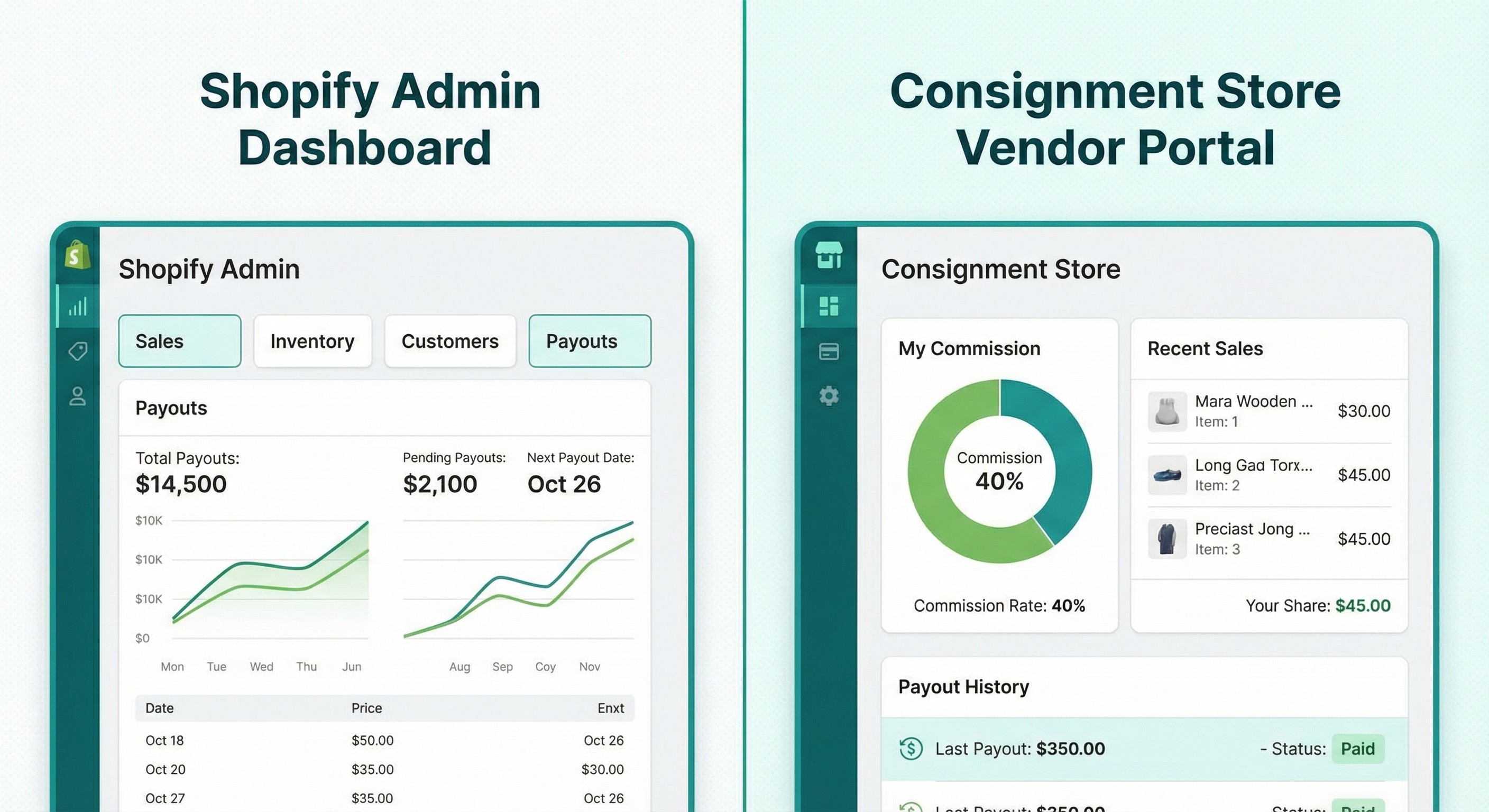
PuppetVendors provides reporting focused on the multi-vendor and consignment use case — sales by vendor, commission summaries, payout history, and vendor performance dashboards. Because everything lives inside Shopify, you also have full access to Shopify's own analytics: the Shopify admin dashboard, Shopify Reports, and any third-party analytics app from the Shopify App Store. There's no split between "in-store reports" and "online reports" because all transactions flow through the same system.
Where SimpleConsign Still Wins
This comparison wouldn't be useful if it didn't acknowledge where SimpleConsign holds genuine advantages.
If you don't use Shopify at all, SimpleConsign is a complete standalone system. It handles POS, inventory, consignor management, payouts, and reporting without needing any other platform. For a consignment store that only sells in-person and doesn't want or need an e-commerce storefront, SimpleConsign provides everything in one place.
If you prioritize phone-based customer support, SimpleConsign's support team consistently receives 95% positive mentions in reviews. Their response time is reported at 30 minutes or less, and users describe the team as responsive and knowledgeable.
If you need consignment-specific compliance features, SimpleConsign includes built-in tools for managing consignment periods, handling expired items, tracking donations, and generating consignment-specific documentation that PuppetVendors handles differently through Shopify's native product management.
Where Shopify + PuppetVendors Wins
If your store is already on Shopify, adding PuppetVendors keeps everything in one system. No dual data entry, no sync issues, no overwritten edits, no separate login for your team.
If you sell both online and in-store, PuppetVendors' Shopify POS Extension means commissions are calculated the same way for every sale, regardless of channel. SimpleConsign cannot do this — their Shopify integration does not work with Shopify POS.
If you want to choose your own payment processor, Shopify supports dozens of payment gateways with transparent, published rates. SimpleConsign requires SimplePay with negotiated (unpublished) rates.
If your consignors are mobile-first, PuppetVendors' vendor portal is mobile-responsive and supports 14 languages. SimpleConsign's interface isn't optimized for mobile devices, which multiple reviewers have flagged.
If you want to use the Shopify app ecosystem, running on Shopify gives you access to thousands of apps for marketing, SEO, email, analytics, loyalty programs, shipping, and more. SimpleConsign integrates with Shopify and QuickBooks. That's it.
If total cost matters, a consignment store with 30 vendors pays $68 per month with Shopify + PuppetVendors versus $398 per month with SimpleConsign Professional + Shopify Basic. That's $3,960 saved per year.
If you want real-time inventory accuracy, PuppetVendors reflects changes instantly because it's reading Shopify's database directly. SimpleConsign's Shopify integration relies on nightly bulk syncs, creating windows where your online store shows stale data.
Decision Framework
Choose SimpleConsign if all of these apply: you operate a brick-and-mortar-only consignment store, you don't sell on Shopify or don't plan to, you prefer a single all-in-one system with its own POS, and you're comfortable with SimplePay as your payment processor.
Choose Shopify + PuppetVendors if any of these apply: your store already runs on Shopify, you sell both online and in-store through Shopify POS, you want to choose your own payment processor, you need real-time inventory sync between your storefront and your consignment management, or you want your consignors to have a mobile-friendly portal in their preferred language.
If you're starting a new consignment store from scratch, the question is really about where you want your foundation to be. SimpleConsign is the foundation itself — a purpose-built consignment system with e-commerce as an add-on. Shopify is the foundation with PuppetVendors adding the consignment layer. For most new stores in 2026, the Shopify foundation offers more flexibility, lower total cost, and a broader ecosystem to grow into.
Frequently Asked Questions
Can I use SimpleConsign with Shopify POS?
No. SimpleConsign's own FAQ confirms that their Shopify integration applies only to Shopify's online platform. They do not integrate with Shopify POS. In-store sales go through SimpleConsign's own POS, and online sales go through Shopify — these are tracked in separate reports.
How much does SimpleConsign cost if I want Shopify integration?
The Shopify integration is only available on SimpleConsign's Professional plan at $359 per month. Add your Shopify subscription (minimum $39 per month) and the total starts at $398 per month. Consignor label printing adds another $125 per month if needed.
Does SimpleConsign sync with Shopify in real-time?
No. SimpleConsign syncs with Shopify through nightly bulk updates. Product changes made in Shopify get overwritten during these syncs. All product updates must be made in SimpleConsign, which serves as the master database.
Can I keep my current payment processor with SimpleConsign?
No. SimplePay is a mandatory integration for all new SimpleConsign customers. Stores that want to use their own payment processor need to choose different software. Transaction fees are negotiated per store and are not published on their website.
Does PuppetVendors work with Shopify POS?
Yes. PuppetVendors includes a Shopify POS Extension. In-store sales processed through Shopify POS automatically flow through PuppetVendors' commission engine with the same rules and calculations as online sales.
How much does Shopify + PuppetVendors cost for a consignment store?
Shopify Basic costs $39 per month. PuppetVendors ranges from $39 per month for up to 15 vendors to $249 per month for unlimited vendors. A typical store with 30 consignors pays around $68 per month total. A store with 100 consignors pays around $138 per month total.
Can I migrate from SimpleConsign to Shopify + PuppetVendors?
Yes. Since SimpleConsign can export data, you can move your product catalog and consignor information to Shopify. PuppetVendors' onboarding supports importing vendor data and setting up commission structures. The main work is re-establishing your consignor relationships in the new vendor portal and ensuring your product data is properly mapped to Shopify's product fields.
Running your consignment store on Shopify? Try PuppetVendors free for 14 days — add commission management, automated PayPal and Stripe payouts, a mobile-friendly vendor portal, and Shopify POS support to your store without leaving Shopify's ecosystem.
Looking beyond SimpleConsign? We compared all 10 consignment software options for Shopify including Circle-Hand, ConsignCloud, Ricochet, and more.