
Subscribe to our Newsletter
SHARE THIS BLOG
Getting your commission split right is the difference between a thriving consignment business and one that either bleeds consignors or bleeds money. This guide breaks down real commission rates across every major consignment vertical — clothing, furniture, art, luxury goods, and digital products — so you can set rates that attract quality consignors while keeping your store profitable.
How Much Do Consignment Shops Charge?
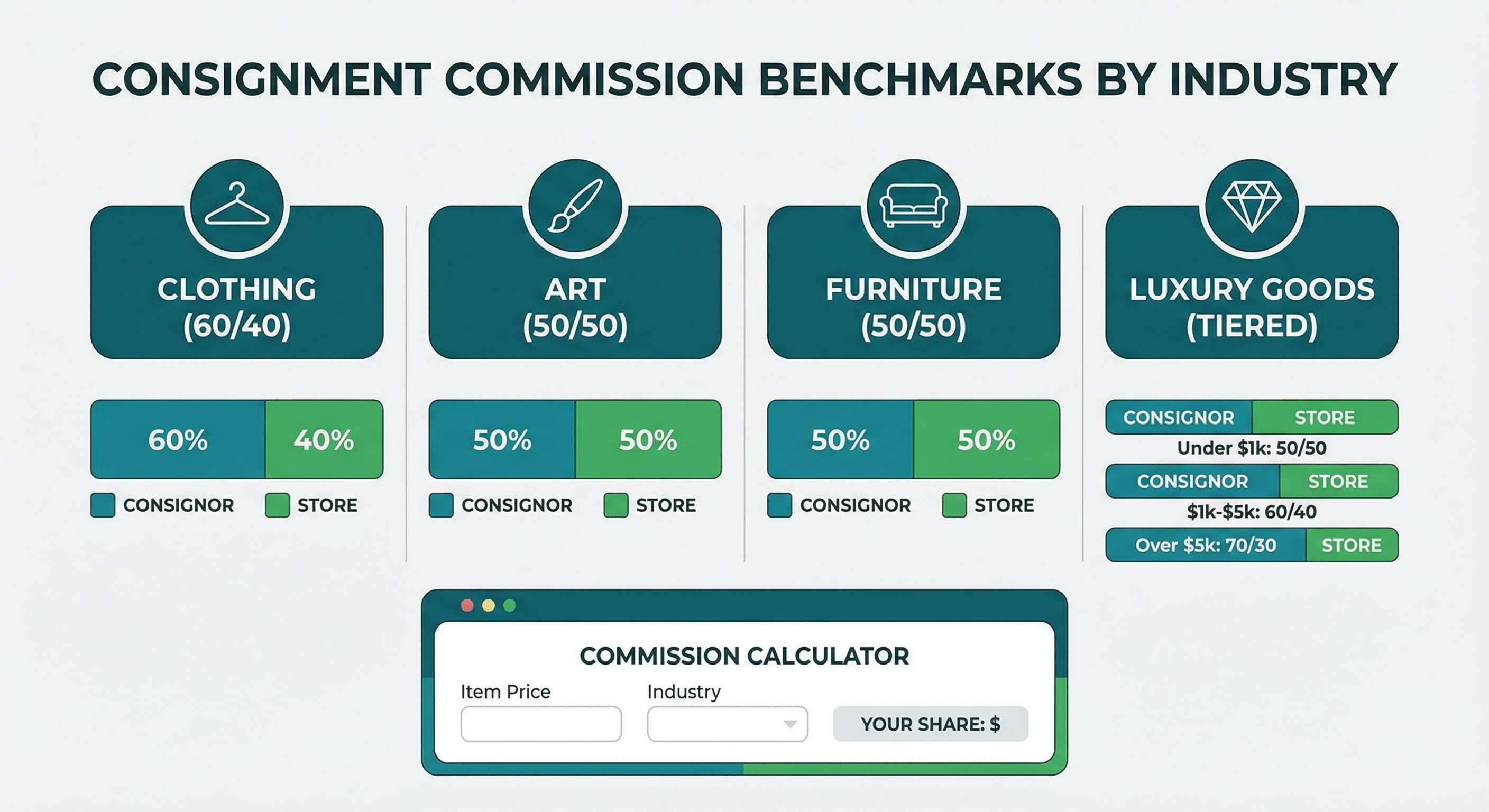
Most consignment shops charge a commission of 30% to 50% of the sale price, so the consignor keeps 50% to 70%. The most common arrangement is a 60/40 split favoring the consignor: the consignor receives 60% and the shop keeps 40%. Higher-value categories like furniture and luxury goods pay consignors more, often 70% to 90%, while lower-priced items frequently use a 50/50 split. You can model any split with our free consignment commission calculator, and the full breakdown by industry is below.
Most consignment store owners agonize over the same question: what percentage should I keep? Set it too high, and consignors take their inventory elsewhere. Set it too low, and you can't cover rent, let alone grow. The reality is that there's no single "correct" commission rate. The right split depends on your vertical, your overhead costs, the value of items you're selling, and how much work you do to market and sell each piece.
What's changed in the last few years is that online consignment has completely reshaped expectations. Platforms like TheRealReal, Poshmark, and Shopify-powered consignment stores have given consignors more options than ever. If your rates aren't competitive with the broader market, your best consignors will find alternatives within minutes.
This guide gives you the industry benchmarks, the formulas for calculating your own rates, and the software strategies to automate commission structures that would be a nightmare to manage manually.
Understanding the Basics: Commission Rate vs. Consignment Percentage
Before diving into specific numbers, it helps to clarify terminology that trips up many new store owners. "Commission rate" and "consignment percentage" describe two sides of the same split, but they're expressed from different perspectives.
The commission rate is what the store keeps. If your commission rate is 40%, you retain $40 from a $100 sale. The consignment percentage (or consignor split) is what the item owner receives — in this case, 60%. When someone refers to a "60/40 split," convention is that the first number goes to the consignor and the second to the store. A "60/40 split favoring the consignor" means the consignor gets 60% and the store keeps 40%.
This distinction matters because different industries express the same arrangement differently. Art galleries typically talk about their commission (what they keep), while clothing consignment shops usually discuss the consignor's percentage (what they pay out). Confusing the two when setting up your software or contracts can lead to costly mistakes.
If you're still in the planning phase, our complete guide to starting a consignment store on Shopify covers everything from niche selection to your first consignor.
The net split — what each party actually takes home — also needs to account for deductions that happen before the percentage is applied. Payment processing fees (typically 2.6-3.5% on Shopify), shipping costs on online orders, and any platform fees all reduce the amount available to split. Whether these come off the top before the split or are absorbed by one party should be spelled out in your consignment agreement. Most stores deduct payment processing fees before calculating the split, which is fairer to both sides since neither party controls those costs.
Commission Rates by Industry
Clothing and Fashion Consignment
Clothing consignment is the largest and most established segment, and it has the most standardized rates. The industry standard is a 60/40 split favoring the consignor: the item owner receives 60% of the sale price, and the store keeps 40%.
However, this standard masks significant variation based on item value, brand tier, and consignment model. Budget and mid-range clothing stores (items under $100) typically operate at 50/50 or even 60/40 favoring the store. The reasoning is straightforward: processing, photographing, tagging, and displaying a $20 shirt takes roughly the same labor as a $200 jacket, so lower-priced items need a higher commission to be worth the shelf space.
Designer and luxury fashion consignment has moved toward more consignor-friendly splits, driven largely by online competition. TheRealReal, the largest luxury consignment platform, uses a tiered structure that pays consignors anywhere from 30% on lower-value items to 85% on watches and jewelry selling above $7,500. Their VIP sellers who move $10,000+ annually unlock even higher rates with loyalty bonuses. This has raised expectations across the entire luxury consignment market. If you're running a brick-and-mortar luxury consignment store, consignors will compare your 50/50 split to TheRealReal's rates and expect justification for the difference.
Children's clothing consignment tends to run at 50/50 or 60/40 favoring the store, reflecting lower price points and the seasonal nature of kids' inventory.
For online Shopify-based clothing consignment, the competitive range sits between 60/40 and 70/30 favoring the consignor. Your overhead is lower than a physical store (no retail lease, fewer staff), and consignors know it. The advantage you offer is a curated audience, professional product photography, and an established Shopify storefront with built-in traffic.
Furniture and Home Goods
Furniture consignment operates differently because of the logistics involved. Moving, storing, staging, and delivering large items costs significantly more than hanging a dress on a rack. The standard split is 50/50, with some stores keeping up to 60% on items that require delivery or special handling.
High-end and antique furniture tends to be more favorable to consignors, typically 60/40 or even 70/30 in their favor. The logic is that a $5,000 dining table generates enough revenue at 30% commission to justify the store's costs, whereas taking only 30% of a $200 bookshelf barely covers the floor space it occupies.
Many furniture consignment stores also charge supplemental fees rather than adjusting the percentage. Pickup fees ($50-$150 depending on distance), cleaning or restoration charges, and storage fees after a certain period are common. These allow the store to maintain a competitive-looking split while ensuring they don't lose money on high-cost logistics.
For Shopify stores selling furniture on consignment, the model is slightly different. You typically don't handle the physical inventory — consignors ship directly to buyers or arrange local pickup. This dramatically reduces your overhead and allows more consignor-friendly splits of 70/30 or even 80/20, since your role is essentially marketplace facilitation rather than full-service retail.
Art Galleries and Online Art Consignment
Art gallery commissions are among the most debated in any consignment vertical. The industry standard is a 50/50 split, and most established galleries will not negotiate below this threshold. Some galleries, particularly in high-rent urban markets, have moved to 60/40 in the gallery's favor, though this is controversial among artists.
The 50/50 standard reflects the substantial investment galleries make in exhibition space, lighting, opening events, marketing to collectors, and often years of relationship-building with buyers. Artists who can sell independently through social media or their own websites sometimes view 50% as excessive, but galleries counter that their curatorial reputation and collector access justify the split.
Online art galleries and artist marketplace platforms have disrupted this model considerably. Because overhead is dramatically lower without a physical gallery space, online platforms can offer artists 60-80% of the sale price. Fine Art America lets artists set their own markup above a base production cost. Saatchi Art operates at approximately 65/35 in the artist's favor for original works. Society6 offers artists 10% on most products but allows them to set their own margin on art prints.
For Shopify store owners running an online art gallery or artist marketplace, this creates a significant competitive opportunity. You can offer artists 70/30 or even 80/20 splits and still maintain healthy margins because your platform costs are a fraction of a physical gallery. The key differentiator becomes the quality of your audience and your ability to drive sales, not your physical space.
Regional and emerging artists are generally more willing to accept standard 50/50 or even 60/40 splits (favoring the gallery) because they value the exposure and credibility. Established artists with existing collector relationships will expect better terms, often 60/40 or 70/30 in their favor.
Luxury Goods and Designer Items
Luxury consignment has become one of the fastest-growing segments, worth an estimated $256 billion globally as of 2025. Commission structures in luxury are almost always tiered by item value, reflecting the reality that a $50 commission on a $500 handbag and a $500 commission on a $5,000 watch represent very different value propositions to the consignor.
TheRealReal's structure serves as the de facto benchmark for online luxury consignment. Base rates start around 55% to the consignor for items in the $200-$300 range, increasing to 70% for items over $5,000. Watches and fine jewelry can earn consignors up to 85-90% on high-value pieces. Their loyalty program further increases payouts based on cumulative annual sales volume.
However, TheRealReal has also faced significant backlash for reducing payouts over time in pursuit of profitability. Active buyers on the platform declined 8% year-over-year in late 2023 as consignors migrated to platforms with better rates. This created an opening for independent luxury consignment operations on Shopify and other platforms to capture disenchanted sellers.
For independent luxury consignment stores, a competitive structure might look like this: 55-60% to consignor for items under $500, 65-70% for items $500-$2,000, and 75-80% for items above $2,000. This undercuts TheRealReal's rates for mid-range items while remaining sustainable for your business.
Authentication costs are a unique consideration in luxury consignment. Whether you absorb these into your commission or charge them separately affects your effective rate. Most successful luxury consignment operations build authentication costs into their commission structure to keep the consignor's experience simple.
Print-on-Demand and Digital Goods
Print-on-demand (POD) and digital consignment operate on fundamentally different economics than physical goods. There's no inventory to store, no shipping to handle (the POD provider manages fulfillment), and each item can sell unlimited times. This changes the commission calculation entirely.
Marketplace-based POD platforms pay artists royalties ranging from 5% to 30% of the sale price. Redbubble lets artists set their own margin above a base cost, with typical markups resulting in 10-20% of the final price going to the creator. Threadless pays around 20% on marketplace sales and 30% through individual artist shops. Zazzle allows royalty rates from 5% to 99%, though higher rates result in higher prices that may reduce sales.
For Shopify stores running a POD consignment or artist marketplace, the opportunity is to offer significantly better rates than the major platforms. Because you control the storefront and the POD integration, you can offer creators 30-50% of the sale price and still cover your fulfillment costs and profit margin. Creators who earn 10-15% on Redbubble will notice a 3x improvement in per-sale revenue.
Digital goods (downloadable art, templates, design files) have even more favorable economics since there's zero marginal cost per sale. Commission structures for digital consignment marketplaces typically range from 30-50% to the store, meaning creators receive 50-70% of each sale. Etsy charges sellers approximately 6.5% in combined listing and transaction fees, plus payment processing. Creative Market takes 40% of each sale. Gumroad charges 10% plus payment processing.
Five Factors That Should Drive Your Commission Rate
1. Your Actual Cost Per Transaction
Before setting any percentage, calculate what it actually costs you to process a consignment sale from intake to payout. This includes staff time for intake inspection, photography and listing creation, storage or display costs per item per day, marketing costs attributed to each sale, payment processing fees, and the time spent managing consignor communications and payouts.
For a typical Shopify-based consignment store, transaction costs run between $5 and $25 per item depending on complexity. A clothing item that takes 10 minutes to photograph, list, and manage might cost $8-$12 in labor. A piece of furniture requiring professional photography and detailed descriptions might cost $20-$30.
Once you know your per-transaction cost, you can calculate the minimum commission percentage needed at each price point. If your cost per transaction is $10 and an item sells for $50, you need at least 20% commission ($10) just to break even on that item — before covering any overhead, platform costs, or profit margin.
2. Item Value and Price Point Distribution
Your commission structure should account for the fact that low-value and high-value items have different economics. A flat 40% commission makes sense across a narrow price range, but it breaks down at the extremes.
On a $15 item, 40% is $6 — which doesn't cover the cost of processing the consignment. On a $2,000 item, 40% is $800 — which is more than generous for what might be the same amount of work. This is why tiered commission structures make sense for most consignment businesses. Lower-priced items should carry a higher commission rate (or a minimum dollar commission per item), while higher-priced items can be more consignor-friendly.
A practical tiered structure might look like: items under $50 carry a 50% commission, items $50-$200 carry 40%, items $200-$500 carry 35%, and items over $500 carry 25-30%. The specific breakpoints depend on your cost structure and competitive environment.
3. Your Competitive Landscape
Your rates don't exist in a vacuum. Consignors — especially experienced ones — will compare your terms to every alternative available to them. This includes other local consignment stores, online platforms (Poshmark, TheRealReal, eBay), direct selling (Facebook Marketplace, Instagram), and other Shopify-based consignment stores.
Research what your direct competitors offer. If every clothing consignment store in your market offers 60/40 and you offer 50/50, you need a compelling reason for consignors to accept the lower split. That reason might be faster sales, a better-quality audience, superior photography, or a more convenient drop-off process — but you need something.
Online-only stores have a broader competitive landscape because consignors aren't limited by geography. Your rates will be compared to national and international platforms, which means you need to differentiate on service, curation, or niche specialization rather than trying to beat TheRealReal on raw payout percentage.
4. Consignor Acquisition Cost and Lifetime Value
Your most profitable consignors are the ones who return repeatedly with high-quality inventory. The commission rate is your primary tool for retaining these people. Consider offering loyalty tiers where the commission rate improves as consignors pass cumulative sales thresholds.
For example, a new consignor might start at a 60/40 split, but after $1,000 in cumulative sales, they move to 65/35. After $5,000, they reach 70/30. This structure rewards loyalty, incentivizes consignors to bring their best inventory to you first, and creates switching costs since moving to a new platform means starting over at the base tier.
TheRealReal pioneered this approach in luxury consignment, and it works across verticals. The incremental cost to you is minimal — a few percentage points on consignors who are already generating significant volume — but the retention value is enormous.
5. The Services You Provide
The more work you do for the consignor, the more commission you can justify. A full-service consignment store that handles pickup, cleaning, photography, listing, marketing, selling, shipping, and customer service is providing substantial value worth 40-50% of the sale price. A marketplace platform where consignors do their own photography and write their own descriptions is providing less value and should charge accordingly — perhaps 15-25%.
Be honest with yourself about which model you're operating. If your "full-service" consignment takes blurry photos and buries listings on page 47 of your store, you're not actually providing the value that justifies a 40% commission. Conversely, if you're running a lean marketplace but providing professional photography services, curated collections, and active social media marketing, you might justify higher rates than a typical marketplace.
Commission Structures Beyond the Flat Percentage
Tiered Commissions by Item Value
As discussed above, tiered commissions adjust the percentage based on the item's sale price. This is the most common advanced structure and the one most consignors intuitively understand.
Implementation tip: make sure your consignment software supports automatic tier calculation. Manually tracking different percentages for different price points across dozens or hundreds of consignors is a recipe for errors and disputes.
Category-Based Commissions
Different product categories can have different commission rates. An art and home goods consignment store might charge 50% commission on furniture (high handling costs), 40% on art (moderate handling), and 35% on jewelry (low handling, high value). This allows you to price each category according to its actual cost to handle and sell.
Volume-Based Commissions
Consignors who bring more inventory get better rates. This works well when you have consignors ranging from individuals with a few items to estates or businesses with hundreds of pieces. Volume commitments help you plan inventory and reduce the per-item acquisition cost.
Time-Based Markdowns with Commission Adjustments
Many consignment stores use automatic price reductions over time: full price for the first 30 days, 25% off for days 31-60, 50% off for days 61-90, and donation or return after 90 days. Some stores adjust the commission split along with the markdown — keeping a higher percentage on discounted items since the absolute dollar amount is lower.
For example, a $100 item at 40% commission earns the store $40. After a 50% markdown to $50, the store might increase its commission to 50%, earning $25 rather than $20. This ensures the store still covers its costs on aging inventory.
Automating Complex Commission Structures on Shopify
Managing different commission rates for different consignors, categories, price tiers, and loyalty levels is precisely the kind of challenge that drives consignment store owners toward general-purpose spreadsheets — and toward mistakes. This is where purpose-built consignment software earns its keep.
PuppetVendors, a Shopify app designed for multi-vendor marketplaces and consignment operations, handles complex commission structures natively. You can set global commission rates across your entire store, then override them at the vendor (consignor) level, the product level, or the category level. This means you can run a tiered structure where your VIP consignors earning 70/30 coexist in the same store with new consignors at 60/40, with furniture carrying different rates than jewelry, all calculated automatically at checkout.
The automated payout system calculates each consignor's earnings after every sale, deducting your commission and any agreed-upon fees, then processes payouts on whatever schedule you set — weekly, bi-weekly, or monthly. For a complete walkthrough of the payout automation setup, including payment methods, minimum thresholds, and return hold periods, see our guide to automating consignor payouts on Shopify. This eliminates the manual reconciliation that eats hours from consignment store owners every payout cycle and reduces disputes because every consignor can see exactly how their earnings were calculated through their vendor portal.
For stores with volume-based or loyalty-based commission tiers, the ability to adjust a single consignor's rate without rebuilding your entire fee structure saves significant administrative time. When a consignor crosses the $5,000 cumulative sales threshold and earns a better split, you update one field and every future sale automatically reflects the new rate.
Common Commission Rate Mistakes
Setting Rates Too Low to Compete
The instinct to attract consignors with aggressive commission rates is understandable but dangerous. If you're keeping only 20-25% on a clothing consignment, you need enormous volume to cover even basic operating costs. A 25% commission on a $40 item is $10 — and if it costs you $8 to process that item, you're making $2. You'd need to sell 2,500 items a month just to cover a $5,000 monthly overhead.
New consignment stores frequently price below sustainability because they're comparing themselves to marketplace platforms with completely different cost structures. Poshmark's 20% fee works because sellers do all the work — photography, listings, shipping, customer service. If you're providing those services, you need a higher commission.
Not Accounting for Returns and Unsold Inventory
Your effective commission rate needs to factor in items that don't sell and get returned to consignors, as well as buyer returns. If 30% of your consignment inventory goes unsold and you've spent time and resources photographing and listing those items, your effective cost per successful sale is significantly higher than it appears.
Build a "shrinkage factor" into your rate planning. If your sell-through rate is 70%, your effective commission on successfully sold items needs to be approximately 1.4x your per-item cost to break even, because the 30% that didn't sell still consumed resources.
Using the Same Rate Across All Categories
A flat commission across dramatically different product categories almost always leaves money on the table in one category and overcharges in another. The work involved in selling a $500 painting (photograph it once, hang it in your online gallery, wait for the right buyer) is completely different from selling a $500 estate lot of 50 vintage items (photograph each piece, write 50 descriptions, manage 50 individual listings).
If both carry the same 40% commission, you're making $200 on each — but the estate lot might have cost you 10x more to process. Category-specific rates solve this without forcing you to turn away otherwise profitable consignment opportunities.
Ignoring Payment Processing Fees in Your Calculations
Shopify Payments charges 2.6% + $0.30 per transaction on the Basic plan. On a $50 sale, that's $1.60 in processing fees. On a $500 sale, it's $13.30. If your commission rate doesn't account for these fees, they eat directly into your margin.
Decide upfront whether processing fees are deducted before the split (reducing both parties' take proportionally) or absorbed by one party. The cleanest approach is deducting them from the gross sale before calculating the split, which most consignors find fair since the fee is outside either party's control.
How to Present Your Commission Rates to Consignors
Transparency wins. The days of burying commission details in fine print are over, especially if you're competing with online platforms that publish their rates publicly.
Create a clear, simple commission schedule and display it prominently in your consignor onboarding materials, on your website, and in your vendor portal. If you use tiered rates, show examples: "A $100 item at our standard 40% commission earns you $60. A $300 item at our 35% commission earns you $195."
Frame the commission as value exchange, not a cost. "Our 40% commission covers professional photography, listing on our Shopify store with 10,000 monthly visitors, social media promotion, customer service, secure payment processing, and guaranteed payout within 7 days of sale." When consignors understand what they're getting for their percentage, the rate feels like a partnership rather than a tax.
Avoid apologizing for your rates. If you've done the math and your commission is fair relative to the services you provide and the market you serve, present it confidently. Consignors who negotiate aggressively on commission before sending their first item are often not your best long-term partners.
Quick Reference: Commission Rates by Vertical
Clothing and fashion: Store keeps 35-50%. Standard split is 60/40 favoring consignor. Online-only stores can go as low as 25-30% commission due to lower overhead.
Furniture and home goods: Store keeps 40-50%. The 50/50 split is standard for full-service stores. Additional fees for pickup and delivery are common.
Art galleries: Gallery keeps 30-60%. The 50/50 split remains the dominant standard. Online galleries operate at 20-40% commission, giving artists 60-80%.
Luxury goods: Store keeps 15-45%, depending heavily on item value. Tiered structures are the norm. Items above $5,000 typically earn consignors 70-85%.
Print-on-demand: Platform keeps 50-90% (includes production costs). Artists/creators receive 10-50% as royalties. Shopify-based POD stores can offer 30-50% to creators.
Vintage and antiques: Store keeps 35-50%. Specialized knowledge and authentication justify rates at the higher end. Rare or high-value items may warrant 70/30 favoring the consignor.
Children's and baby items: Store keeps 40-60%. Higher commission reflects lower price points and seasonal turnover. Items often have short shelf lives.
Sporting goods and outdoor equipment: Store keeps 30-40%. The 60/40 or 70/30 split favoring consignors is common. Condition grading and functionality testing justify the store's share.
Frequently Asked Questions
What is a fair consignment commission rate?
A fair commission depends on your vertical and the services you provide. For clothing consignment, 35-40% retained by the store is standard. For art, 50% is the gallery norm. For luxury goods, tiered rates from 15-45% depending on item value are typical. The test of fairness is whether the rate covers your costs, provides a reasonable margin, and remains competitive enough to attract quality consignors.
What is the standard consignment split for clothing?
The most common split in clothing consignment is 60/40, meaning the consignor receives 60% and the store keeps 40%. Online-only clothing consignment stores often offer more favorable splits of 65/35 or even 70/30 because their overhead is lower than brick-and-mortar shops.
How much commission do art galleries charge?
Most art galleries charge 50% commission on sales, making the standard split 50/50 between artist and gallery. Some high-end galleries in expensive markets charge up to 60%, while online galleries and artist marketplaces typically charge between 20% and 40%.
Should I use a flat commission or tiered structure?
Tiered structures work better for most consignment businesses because they account for the different economics of low-value versus high-value items. A flat percentage is simpler but often results in overpaying on expensive items or undercharging on cheap ones. If your inventory spans a wide price range (e.g., $20 to $2,000), tiered commissions are almost always more sustainable.
How do I handle commission on items that don't sell?
Most consignment agreements don't charge a commission on unsold items — the consignor simply gets their inventory back. However, some stores charge a nominal listing or processing fee (typically $2-$10 per item) to cover the cost of photographing and listing items regardless of whether they sell. This is most common when the store invests significant upfront resources in each item.
Can I charge different commission rates for different consignors?
Yes, and many successful consignment stores do exactly this. Volume-based discounts reward your best consignors with lower commission rates as they bring more inventory. You'll need consignment software that supports per-vendor commission settings rather than a single global rate. PuppetVendors on Shopify allows you to set individual commission rates for each vendor alongside your global defaults.
What commission rate should I charge for an online consignment store?
Online consignment stores typically charge 25-40% commission, lower than brick-and-mortar stores (35-50%) because overhead is lower. The exact rate depends on the services you provide — if you handle photography, listings, customer service, and shipping, 35-40% is justified. If consignors manage their own listings through a vendor portal, 20-30% is more appropriate.
How do payment processing fees affect commission calculations?
Payment processing fees (typically 2.6-3.5% on Shopify) reduce the total available revenue from each sale. Best practice is to deduct these fees from the gross sale price before calculating the commission split. On a $100 sale with a 2.9% processing fee, the net revenue is $97.10. A 40% commission on $97.10 is $38.84 to the store and $58.26 to the consignor. This approach is transparent and fair to both parties.
How much do consignment shops charge?
Most consignment shops charge a commission of 30% to 50% of the sale price. The consignor keeps the rest, typically 50% to 70%. A 60/40 split favoring the consignor (the store keeps 40%) is the most common standard, though furniture and luxury categories often pay consignors 70% to 90%.
What is a fair consignment percentage?
A 60/40 split favoring the consignor is widely considered fair for clothing and general merchandise. What counts as fair depends on your category and the work involved: the more you invest in photography, marketing, and selling each item, the higher a commission (40% to 50%) is justified.
What is the average consignment percentage?
On average the store keeps 30% to 50% commission and the consignor receives 50% to 70%. Brick-and-mortar stores tend toward 35% to 50% because of higher overhead, while online consignment stores average 25% to 40%.
Managing multiple commission rates, consignor tiers, and automated payouts is one of the biggest operational challenges in consignment. PuppetVendors handles all of it natively on Shopify — set per-vendor commission rates, automate payout calculations, and give every consignor a self-service portal to track their sales and earnings. Start your free trial and see how automated commission management saves hours every payout cycle.